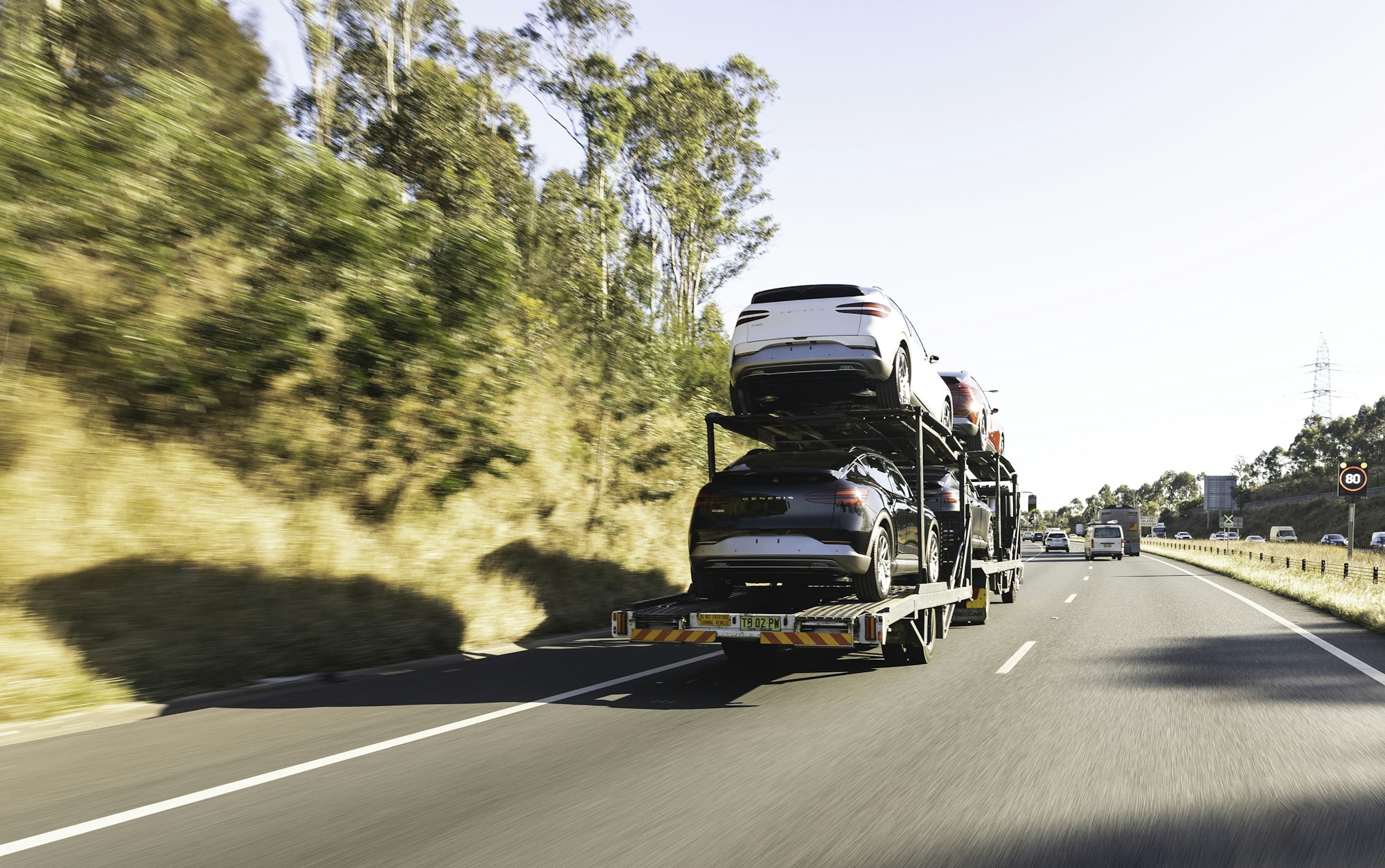
The spread across sources is wide because car shipping is a quote business with no fixed rate card. A carrier's price moves with the route, the season, your vehicle and how soon you need it. Use the tables below to see whether a quote makes sense, and read the section on quotes before you pay a deposit to anyone.
Open-carrier cost by distance
| Distance | Per mile (ShipACar) | Typical total (ShipACar) | Sedan, open (FreightWaves) | Per mile (FreightWaves) |
|---|---|---|---|---|
| Under 300 miles | about $2.00 | about $450 | $540–$1,100 (under 500 mi) | $1.25–$2.00 |
| 300 to 600 miles | about $1.45 | about $650 | $700–$1,800 (500–1,500 mi) | $0.65–$1.20 |
| About 1,000 miles | about $1.05 | about $1,100 | $700–$1,800 (500–1,500 mi) | $0.65–$1.20 |
| 2,500 miles and up | about $0.60 | about $1,650 | $1,050–$3,000+ (1,500+ mi) | $0.55–$0.95 |
What drives the price
Six things matter, in roughly this order.
Distance and route
Longer trips cost more in total and less per mile. ShipACar's numbers show it clearly: about $450 for a trip under 300 miles, $650 at 300 to 600 miles, $1,100 near 1,000 miles and $1,650 at 2,500 miles and up. A short hop of 94 miles still cost $309 in Move.org's test, which is about $3.29 per mile.
Vehicle size and weight
SUVs and trucks take more room on a trailer. FreightWaves' table puts a truck at $900–$1,850 for 500–1,500 miles against $700–$1,500 for a sedan on the same distance.
Open or enclosed
About 75% of shipments move on open carriers, according to ParcelPath, so open is the default. Enclosed costs 30% to 60% more and is the choice for classic, exotic or low-slung cars.
Does it run?
A car that cannot roll under its own power needs a winch or forklift. FreightWaves adds $150 to $300 (its FAQ says $150 to $350), and Move.org's Baltimore to Myrtle Beach quotes ran $140 higher for a non-running car in each of three vehicles.
Metro or rural pickup
FreightWaves lists pickup and delivery location among the factors. Drivers prefer big-city lanes where trailers fill easily.
Season and flexibility
See the timing section below.
Open vs. enclosed transport (FreightWaves)
| Distance | Open | Enclosed |
|---|---|---|
| 500 miles | $600–$700 | $850–$1,000 |
| 1,000 miles | $650–$800 | $1,000–$1,200 |
| 2,000 miles | $1,200–$1,400 | $1,700–$2,000 |
Cost by vehicle type, open carrier (FreightWaves)
| Vehicle | Under 500 miles | 500–1,500 miles | 1,500+ miles |
|---|---|---|---|
| Sedan | $540–$900 | $700–$1,500 | $1,050–$3,000+ |
| SUV | $600–$1,100 | $800–$1,700 | $1,200–$3,200+ |
| Truck | $650–$1,150 | $900–$1,850 | $1,300–$3,400+ |
Sample quotes from Move.org's Montway tests (October 2025)
| Route | Distance | Open | Enclosed |
|---|---|---|---|
| San Diego, CA to Boston, MA | 3,038 mi | $1,429 | $2,029 |
| Portland, OR to Denver, CO | 1,241 mi | $1,139 | $1,569 |
| Dodge City, KS to Roswell, NM | 435 mi | $699 | $1,009 |
| Greensboro, NC to Charlotte, NC | 94 mi | $309 | $439 |
Open or enclosed: which one to book
Open carriers are the standard way cars move, and ParcelPath puts them at about 75% of shipments, with eight to ten vehicles per trailer. Your car rides exposed to weather and road debris, just as it would if you drove it.
Enclosed carriers cost more and protect the car from the elements, which most owners of ordinary cars do not need to buy. In Move.org's Montway quotes, enclosed added $310 to $600 on the three routes of 435 miles or more, or about 40% on the two longest. Over FreightWaves' examples, it adds $250 to $300 at 500 miles, $350 to $400 at 1,000 and $500 to $600 at 2,000.
A sensible rule: ship a daily driver open, and pay for enclosed when the car is valuable or delicate enough that the extra few hundred dollars is cheap protection. If the car is worth little more than the shipping bill itself, compare selling it and buying again near your new home. I could not find a source that tracks that comparison, so run your own numbers.
When to ship: season and booking window
Prices are highest in spring and summer, according to FreightWaves, when demand spikes. ShipACar says summer relocations and winter snowbird lanes firm up rates and that fall usually prices best. ParcelPath gives the biggest numbers: summer can cost 20% to 30% more than winter, and November to March offers savings of up to 30% compared with peak summer pricing. Its sourcing is not documented, so treat the percentages as a rough guide, not a rule.
Move.org's quotes were built with a one-week lead time. Being flexible on pickup dates matters because a broker needs time to find a carrier on your lane. Montway's own FreightWaves review notes quotes expire after seven days if you do not book, which is a reason not to collect quotes weeks before you are ready.
Transit time is the other cost. ParcelPath lists one to three days for under 500 miles, three to five days for 500 to 1,000 miles, six to nine days for 1,000 to 2,500 and seven to ten days beyond that. Carriers cover 400 to 500 miles a day, so you will not get a door-to-door delivery on a two-day deadline across the country.
How quotes work, and how they go wrong
Most online quotes are estimates, not contracts. Move.org says final prices depend on how many carriers bid on the job and found that prices can rise about 25% for companies that do not guarantee their quotes. FreightWaves notes that Montway does not offer binding online quotes, so the price can change after booking.
The patterns to watch for: a quote far below every other, a large deposit up front, a refusal to name the carrier or the pickup window, and a contract with no cancellation terms. For Montway, FreightWaves reports no upfront deposit, a $249 fee if you cancel after a carrier is dispatched, and a 30-day price lock called the TruePrice Guarantee that covers operable, factory-standard vehicles only. Those are company-specific terms, so read them as an example of what to look for, and ask every company the same questions.
Get three quotes for the same dates and vehicle. If one is more than 25% below the others, ask what it excludes before you pay anything.
Insurance and what is covered
Carriers must carry cargo insurance, and Move.org says liability coverage runs $100,000 to $250,000. Montway adds $250,000 of contingent cargo coverage that applies if the carrier's policy lapses, according to FreightWaves and Move.org. Personal belongings are typically not covered by carrier cargo insurance, so take everything out of the car, including toll tags and anything of value.
Before the car is picked up, document its condition. Photograph every side, the interior and the odometer, and review the inspection report that the driver signs at pickup. Read what the driver writes down before you sign it.
ParcelPath says damage rates are below 2% industry-wide for reputable carriers, and the page does not document where it comes from, so treat it as a claim rather than a statistic. Check your own auto policy to see whether it covers a car in transit.
Is shipping worth it vs. driving it yourself?
For a move under 300 miles, you are paying about $2.00 a mile or around $450 total, and driving the car yourself is usually cheaper. Past 1,000 miles shipping starts to pencil out: about $1,100 can compete with the fuel, lodging and time of a long drive, though you still have to get yourself and your belongings to the new home.
If you are renting a truck for your household goods, towing the car adds fuel and equipment costs that vary by truck, so compare quotes from the truck rental company. Our cheapest way to move guide covers the combos. For the long-haul case in detail, see the cross-country car shipping cost guide.
A real-world example
Sample quote: 2023 Honda CR-V, Baltimore to Myrtle Beach (about 500 miles), not running, open carrier
- Open carrier, vehicle running (Move.org's October 2025 test quote)
- $709
- Non-running vehicle surcharge (inoperable quote $849 minus running $709)
- $140
- Total
- $849
An illustration based on one published test quote, not a current price. Prices change with season and carrier availability.
How to pay less
- Be flexible on pickup. A few days of leeway lets a broker find a carrier already on your lane.
- Ship in fall or winter if you can, since FreightWaves and ShipACar both name spring and summer as the expensive seasons.
- Choose open transport for a normal car. Enclosed added $430 to $600 on the two longest routes in Move.org's quotes.
- Meet the driver at a big-road location if the driver cannot reach your street. FreightWaves lists metro or rural pickup as a cost factor, so a convenient pickup spot can help.
- Make sure the car runs. A non-running car adds $140 to $350 depending on the source.
- Get three quotes for the same dates and avoid the one that is far below the rest. Move.org found prices can rise about 25% after booking at companies that do not guarantee them.
Questions people ask
How much does it cost to ship a car?
About $900 to $1,550 for most single-car moves on an open carrier, and about $1,100 for 1,000 miles (ShipACar, September 2026). FreightWaves lists a broader range of $540 to $3,000+ depending on distance.
What is the cost per mile to ship a car?
About $2.00 a mile under 300 miles, $1.45 at 300 to 600 miles, $1.05 near 1,000 miles and $0.60 at 2,500 miles and up (ShipACar). Per-mile rates fall as distance rises.
How much more is enclosed car shipping?
About 30% to 60% (FreightWaves), roughly a third (ShipACar) or 40% to 60% (ParcelPath). On the longer routes in Move.org's quotes the gap was $430 to $600.
How long does car shipping take?
ParcelPath lists one to three days under 500 miles, three to five days for 500 to 1,000 miles, six to nine days for 1,000 to 2,500 and seven to ten days over 2,500 miles.
Is it cheaper to ship a car or drive it?
For trips under about 300 miles, driving is usually cheaper. Over 1,000 miles shipping costs about $1,100, which can compete once you count fuel, lodging and time.
Do car shippers require a deposit?
It depends on the company. FreightWaves reports Montway requires no upfront deposit and charges $249 to cancel after dispatch. Be wary of any company that asks for a large deposit before assigning a carrier.
Does car shipping insurance cover my belongings?
Typically no. FreightWaves says personal belongings are not usually covered by carrier cargo insurance, so remove them before pickup.
Sources
- What is the average cost to ship a car per mile?, ShipACar, checked November 23, 2026per-mile and total price by distance, middle-half range, enclosed premium, seasonal notes (updated September 5, 2026)
- How Much Does It Cost To Ship a Car in 2026?, FreightWaves, checked November 23, 2026ranges by distance, open vs enclosed, vehicle type, non-running surcharge, cost factors
- Montway Auto Transport Review, Move.org, checked November 23, 2026sample quotes by route, non-running difference, quote methodology, insurance (October 2025 data)
- Montway Auto Transport Review, FreightWaves, checked November 23, 2026deposit, cancellation fee, quote expiry, cargo insurance
- Coast to Coast Auto Transport, ParcelPath, checked November 23, 2026transit times, enclosed premium, seasonal percentages, share of open carriers